Batteries & energy · Deep dive
LFP vs NMC: the two battery chemistries that split the EV market
An LFP pack cost $81 per kWh in 2025. The nickel equivalent cost $128. That $47 gap explains most of what has happened to electric car prices, and to the league table of who builds the cells.
By Michael Westergaard · 12 Sept 2026 · 6 min
In BloombergNEF's 2025 battery price survey, the average lithium-iron-phosphate pack cost $81 per kilowatt-hour. The average nickel-manganese-cobalt pack cost $128. On a 60 kWh car that is a difference of roughly $2,800 in the single largest line of the bill of materials, before anyone has argued about anything else.
That gap is the reason the cheap electric car exists. It is also why the list of the world's largest battery makers looks the way it does, and why two of the companies on it are Chinese.
What the names actually refer to
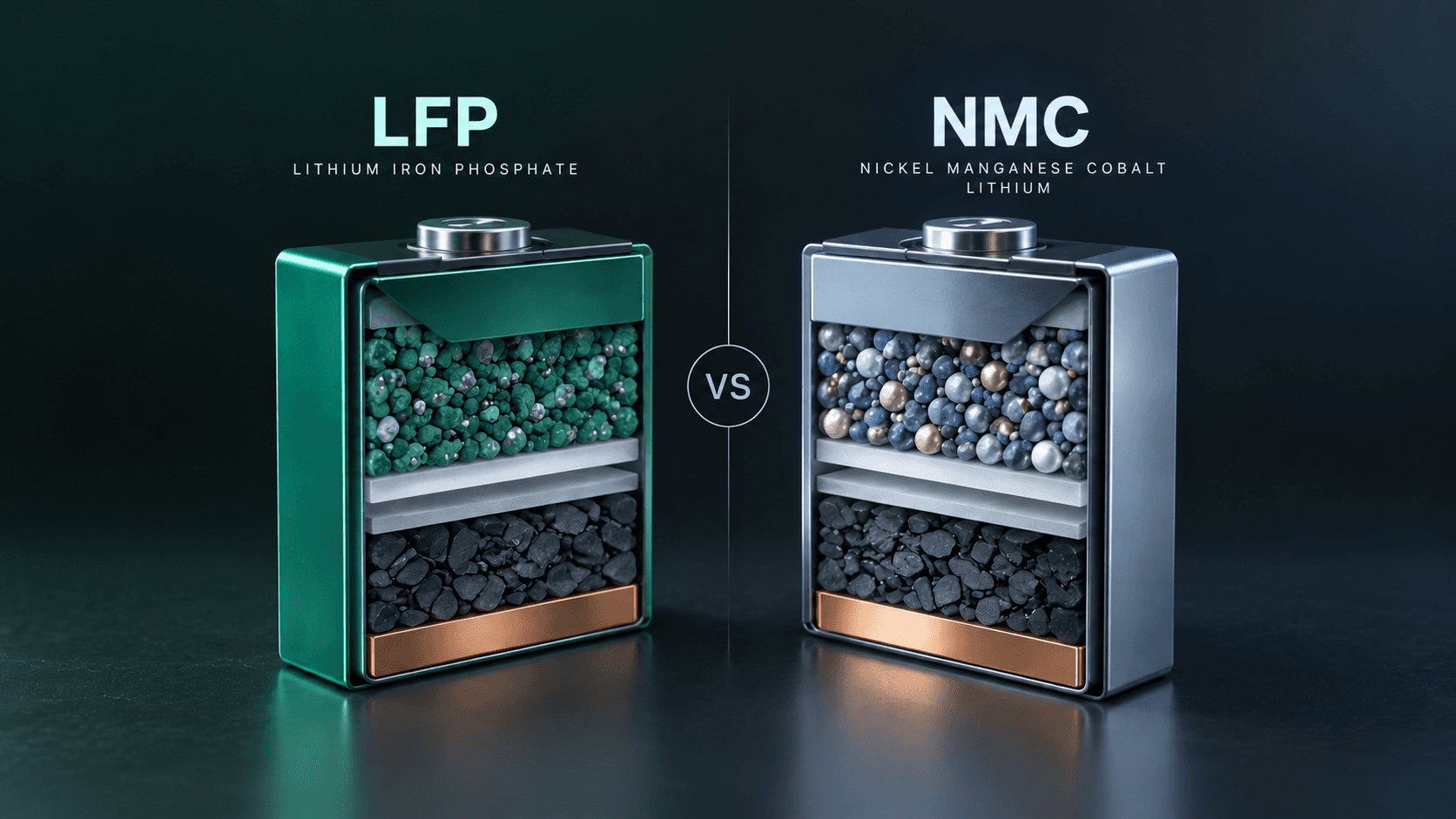
Both are lithium-ion batteries. The difference is the cathode, and only the cathode.
LFP uses lithium iron phosphate. Iron and phosphate are abundant and cheap, and the structure is thermally stable. NMC uses lithium nickel manganese cobalt oxide, where the nickel carries the energy density and the cobalt has historically carried both the price and the supply-chain controversy.
There is no third variable. Everything below follows from those two recipes.
The trade, in one table
| LFP | NMC | |
|---|---|---|
| Cell energy density | 90 to 160 Wh/kg, high-end variants to about 205 | 150 to 250 Wh/kg |
| Typical cycle life | 3,000 to 10,000+ | 1,000 to 3,000 |
| Average pack price, 2025 | $81/kWh | $128/kWh |
| Cathode decomposition | about 270°C | about 210°C |
| Cobalt content | None | Yes, though falling per kWh |
| Cold-weather behaviour | Weaker; noticeable range loss below freezing | Better retained capacity in cold |
Two rows in that table carry most of the weight.
The density row is the case for nickel and it is real: on the cell, NMC stores meaningfully more energy per kilogram. A long-range car with a heavy battery made of cheap cells is a car carrying weight it has to spend energy moving.
The price row is the case for LFP, and it got decisive once EV pricing became competitive rather than aspirational. A 35% cheaper pack is not a rounding difference in a market where manufacturers are fighting over single points of gross margin, which is the fight we describe in what EV gross margin actually measures.
How LFP escaped its own weakness
The density gap should have kept LFP in cheap short-range cars permanently. It did not, because the industry stopped optimising the cell and started optimising the pack.
Conventional packs wrapped cells into modules and modules into a housing, and a large fraction of the volume was structure rather than battery. Cell-to-pack designs, of which BYD's Blade architecture is the best-known, delete the module layer and let the cells carry load. LFP's thermal stability is what makes that safe to do: cells that are unlikely to run away can be packed tightly against each other.
The result is that a chemistry with worse density per kilogram can deliver competitive usable energy per vehicle. The comparison that matters to a buyer is range for the money, and at pack level LFP closed enough of the gap to win on price.
LFP did not beat nickel on physics. It beat it on packaging, and then on price.
Who that made rich
Chemistry share moved fast. Lithium iron phosphate accounted for 40% of global EV battery capacity deployed in 2024 measured in GWh, up from 32% in 2023, with nickel-based chemistries splitting most of the rest.
The maker league table reflects it. Global EV battery installations reached 1,187 GWh in 2025, up 31.7% on the year, and the top of the table is concentrated to a degree that is unusual in any manufacturing industry.
Global EV battery installations, 2025
CATL and BYD together account for roughly 55% of the world's EV battery installations. Both built their positions on LFP at a point when Korean and Japanese makers were committed to nickel: LG Energy Solution, Panasonic and Samsung SDI hold 9.2%, 3.7% and 2.4% respectively.
That is not a story about manufacturing competence. It is a story about a chemistry bet placed around 2020 that took four years to pay, and BYD's position is doubly useful to it because the company consumes its own cells in its own cars, a vertical integration we cover in Chinese EV brands: who owns what.
Where nickel still wins
LFP's victory is not total, and the cases where it loses are specific.
Long-range and performance vehicles still favour nickel, because at some point the weight of a cheap pack costs more range than the cheap pack buys. Cold climates favour nickel: LFP loses usable capacity below freezing more sharply, which matters a great deal in Scandinavia and rather less in southern China. And heavy-duty applications where mass is the constraint keep choosing density.
The clean generalisation is that LFP took the standard-range car and almost all of grid storage, where weight is irrelevant and cycle life is everything, while nickel retained the top of the range.
- To 2020Nickel chemistries are the default for EVs; LFP is treated as a budget option for short-range city cars
- 2020Cell-to-pack designs, notably BYD's Blade, recover much of LFP's density disadvantage at vehicle level
- 2023LFP reaches 32% of global EV battery capacity deployed
- 2024LFP reaches 40%, with nickel chemistries splitting most of the remainder
- 2025Average LFP pack price falls to $81/kWh against $128/kWh for NMC; overall pack prices hit a record low $108/kWh
What to watch next
The cost gap is the variable that decides how far LFP goes. It widened partly because lithium and cobalt prices moved, and BloombergNEF noted that 2025's 8% overall price fall happened despite rising metal costs, which means overcapacity and competition were doing the work rather than cheap inputs. That is not a permanently repeatable source of savings.
The other thing to watch is sodium-ion, which trades away roughly a third of LFP's energy density in exchange for removing lithium from the cost base entirely. It is the same argument one step further down: density given up for price, viable wherever weight does not matter. Grid storage first, vehicles maybe never.
Sources
- Lithium-ion battery pack prices fall to $108 per kilowatt-hour (BloombergNEF, 2025 survey)
- BNEF: Li-ion battery pack prices fall to $108/kWh (Energy Storage News)
- LFP now commands 40% of the global EV battery market (Adamas Intelligence)
- SNE Research: CATL continues to dominate the global battery market (electrive)
- Global EV battery market share in 2025: full rankings (CnEVPost)
- Electric vehicle batteries, Global EV Outlook 2026 (IEA)
- LFP vs NMC battery comparison: safety, lifespan, cost (Ufine Battery)
- LFP, NMC and sodium-ion compared (Battery MBA)
- Density, cycle-life and decomposition-temperature figures are published ranges from battery-industry references and vary by cell design; they are reproduced as ranges rather than as single measured values.
Related reading
Northline Post publishes information and opinion, not investment advice. Nothing here is a recommendation to buy or sell any security. The author may hold positions in companies covered.