EV & mobility · Deep dive
Chinese EV brands: who owns what
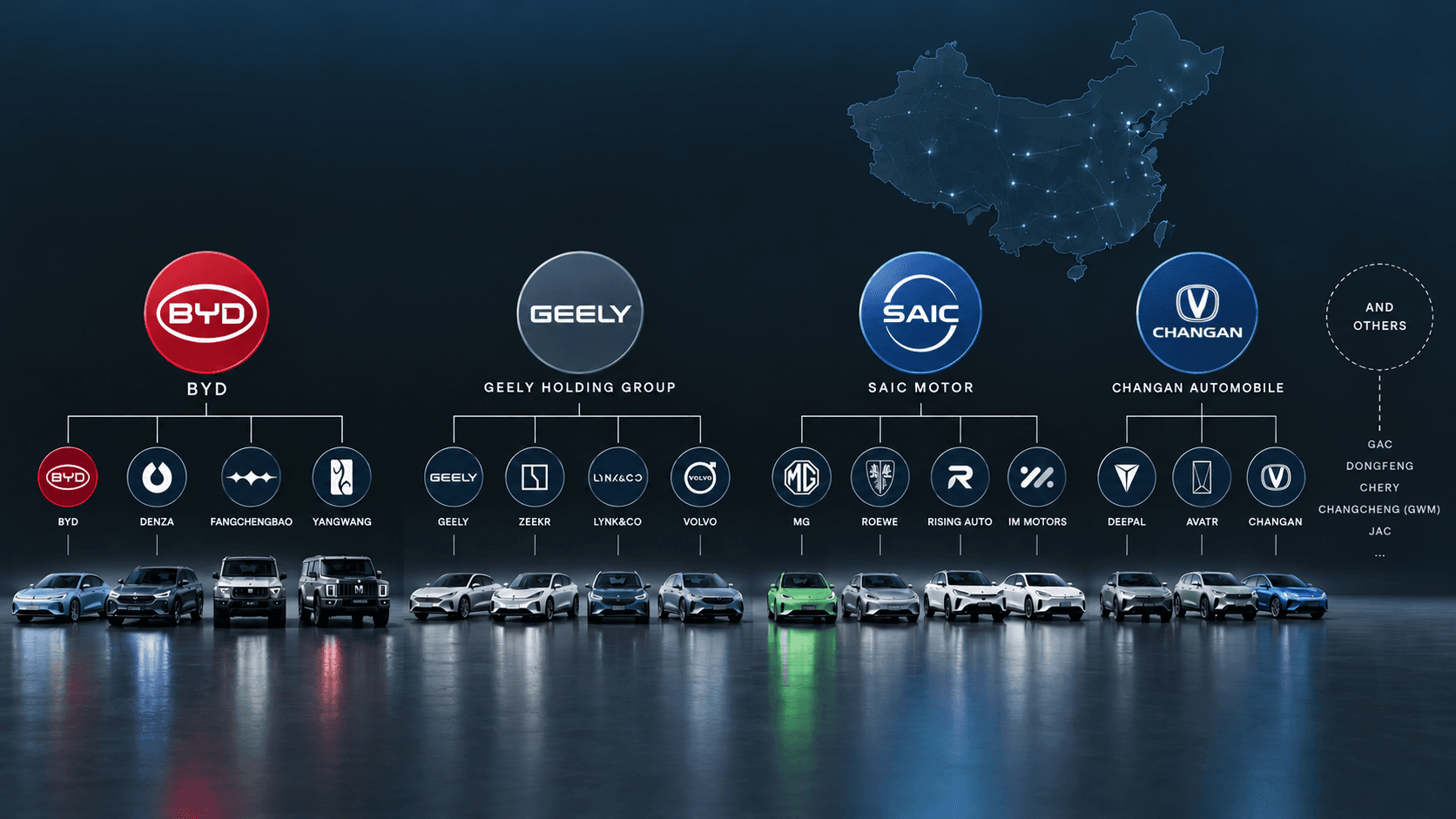
Denza, Yangwang, ONVO, MONA, Zeekr, Lynk & Co, MG, Avatr. Most of the names arriving in Europe belong to seven groups, one of which also owns Volvo, and one phone company that owns no carmaker at all.
By Michael Westergaard · 12 Sept 2026 · 10 min
A European buyer looking at Chinese electric cars in 2026 meets perhaps thirty brand names. Behind them sit far fewer companies. Seven groups account for most of what is actually sold, one of them also owns Volvo and Polestar, and a further cluster of names belongs to a telecommunications company that does not own a car factory at all.
The names are not marketing noise. Each one usually marks a real decision about price, distribution and, in one case, the shape of the charging network. But reading the market requires knowing which badge rolls up to which balance sheet, because the delivery numbers that move a share price are reported at the parent.
| Parent | Brand | Position | From |
|---|---|---|---|
| BYD | BYD | Mass market | 1995 |
| BYD | Denza | Premium | 2011, wholly BYD-owned since 2024 |
| BYD | Yangwang | Above CNY 1m | Jan 2023 |
| BYD | Fangchengbao | Off-road | Jun 2023 |
| NIO | NIO | Premium, battery swap | 2014 |
| NIO | ONVO | Family, mass market | May 2024 |
| NIO | Firefly | Small and cheap | Nov 2024 |
| XPeng | XPeng | Mid to premium | 2014 |
| XPeng | MONA | Entry level | Aug 2024 |
| Li Auto | Li Auto | Family SUV | 2015 |
| Geely Holding | Geely | Mass market | 1997 |
| Geely Holding | Zeekr | Premium electric | Mar 2021 |
| Geely Holding | Lynk & Co | Young urban, subscription | 2016 |
| Geely Holding | Volvo | European premium | Bought from Ford in 2010 |
| SAIC | MG | Export volume | British badge, SAIC-owned since 2007 |
| SAIC | Roewe | Domestic mass market | 2006 |
| SAIC | Rising Auto | Mid electric | 2021 |
| SAIC | IM Motors | Premium electric | Dec 2020 |
| Changan | Changan | Mass market | 1984 |
| Changan | Deepal | Mid electric | 2022 |
| Changan | Avatr | Premium, Huawei and CATL partnered | 2018, renamed 2021 |
| Seres | Aito | Huawei-partnered premium | 2021 |
| Chery | Luxeed | Huawei-partnered | 2023 |
| BAIC | Stelato | Huawei-partnered executive | 2024 |
| JAC | Maextro | Huawei-partnered ultra-luxury | 2024 |
| SAIC | Shangjie | Huawei-partnered mass market | 2025 |
BYD: four brands stacked by price
BYD runs the clearest ladder in the market, and it built it in eighteen months.
Denza is the oldest and the one with the most tangled history. It began in February 2011 as a 50/50 new-energy joint venture between BYD and Daimler. Mercedes-Benz cut its holding to 10% in 2021 after weak sales, BYD moved to 90% under an equity transfer agreed in January 2022, and in September 2024 Mercedes-Benz transferred the last 10%, ending a thirteen-year partnership. Denza is now wholly BYD's, which is worth remembering whenever the brand is described as a Mercedes tie-up: it has not been one for years.
Yangwang arrived in January 2023 at the top of the range, priced above CNY 1m and aimed squarely at European luxury marques. Fangchengbao followed in June 2023, pointed at off-road and adventure buyers rather than at a price tier.
That gives BYD four price points under one manufacturing base, which is the whole strategic point. It is also why BYD's group gross margin is such an awkward number to interpret, a problem we take apart in what EV gross margin actually measures.
NIO: three brands, one battery-swap network
NIO is the only group in this piece whose brand structure is dictated by infrastructure. Its battery-swap stations are a large fixed cost, and the economics improve with every car that flows through them.
ONVO launched in May 2024 as the volume brand, starting with the L60. Firefly was announced as the third brand in November 2024 and began deliveries in April 2025, aimed at small, cheap cars and, unusually, given swap stations of its own rather than sharing the existing network.
NIO is also the only one of these groups that publishes a monthly split by brand, which makes it the only one where the strategy can be checked against the numbers rather than taken on trust.
- NIO
- ONVO
- Firefly
| Period | NIO | ONVO | Firefly | Vehicles delivered (total) | Source |
|---|---|---|---|---|---|
| Jan 25 | 7,951 | 5,912 | — | 13,863 | NIO January 2025 delivery update |
| Feb 25 | 9,143 | 4,049 | — | 13,192 | NIO February 2025 delivery update |
| Mar 25 | 10,219 | 4,820 | — | 15,039 | NIO March 2025 delivery update |
| Apr 25 | 19,269 | 4,400 | 231 | 23,900 | NIO April 2025 delivery update |
| May 25 | 13,270 | 6,281 | 3,680 | 23,231 | NIO May 2025 delivery update |
| Jun 25 | 14,593 | 6,400 | 3,932 | 24,925 | NIO June 2025 delivery update |
| Jul 25 | 12,675 | 5,976 | 2,366 | 21,017 | NIO July 2025 delivery update |
| Aug 25 | 10,525 | 16,434 | 4,346 | 31,305 | NIO August 2025 delivery update |
| Sep 25 | 13,728 | 15,246 | 5,775 | 34,749 | NIO September 2025 delivery update |
| Oct 25 | 17,143 | 17,342 | 5,912 | 40,397 | NIO October 2025 delivery update |
| Nov 25 | 18,393 | 11,794 | 6,088 | 36,275 | NIO November 2025 delivery update |
| Dec 25 | 31,897 | 9,154 | 7,084 | 48,135 | NIO December 2025 delivery update |
| Jan 26 | 20,894 | 3,481 | 2,807 | 27,182 | NIO January 2026 delivery update |
| Feb 26 | 15,159 | 2,981 | 2,657 | 20,797 | NIO February 2026 delivery update |
| Mar 26 | 22,490 | 6,877 | 6,119 | 35,486 | NIO March 2026 delivery update |
| Apr 26 | 19,024 | 5,352 | 4,980 | 29,356 | NIO April 2026 delivery update |
| May 26 | 20,013 | 12,029 | 5,663 | 37,705 | NIO May 2026 delivery update |
| Jun 26 | 21,908 | 11,743 | 6,946 | 40,597 | NIO June 2026 delivery update |
| Jul 26 | 20,008 | 10,155 | 5,771 | 35,934 | NIO July 2026 delivery update |
| Aug 26 | 21,174 | 8,810 | 5,852 | 35,836 | NIO August 2026 delivery update |
Source: NIO August 2026 delivery update
The chart is not flattering to the plan. We looked at what it implies in NIO's brand mix inversion.
XPeng: one brand, plus the one that outsold it
XPeng added MONA in August 2024, launching the M03 hatchback at CNY 119,800, comfortably its cheapest car. The sub-brand worked faster than almost any comparable launch: the M03 sold roughly 197,500 units in 2025, about 46% of XPeng group volume.
That is the outcome ONVO was meant to produce for NIO and did not. Two companies of similar size launched a cheap sub-brand within four months of each other; one of them now depends on it for nearly half its volume.
Li Auto: the group that did not split
Li Auto is the interesting negative case. It sells under one badge and has resisted adding a cheaper marque, concentrating instead on a narrow range of family SUVs. Whether that is discipline or a missed cycle is genuinely arguable, and its recent margin record gives both sides material.
Geely: a holding company with a Swedish carmaker inside it
Geely is the group that confuses European readers most, because several of the brands it owns do not sound Chinese at all.
Zhejiang Geely Holding Group is the parent. Under it sit Geely Auto, listed in Hong Kong, and, held separately, Volvo Cars, which Geely Holding bought from Ford in 2010 and floated in Stockholm in 2021 while keeping control. Polestar and Lotus belong to the same holding company. A European buyer cross-shopping a Volvo EX30 against a Zeekr is choosing between two brands with one ultimate owner.
Geely is also the counter-example to everything else in this piece. While the others were adding badges, Geely was removing them. Zeekr, launched in March 2021 as the premium electric brand, took a controlling stake in Lynk & Co, which had been a Geely and Volvo joint venture since 2016. Geely Auto then moved to buy in the Zeekr shares it did not already own, barely a year after listing them in New York. Two brands became one structure, and a separately listed subsidiary was folded back into its parent.
That is worth watching, because it is the first serious evidence that the brand-proliferation phase has an end.
SAIC: the export brand is British
SAIC Motor was for years China's largest carmaker by total volume, on the strength of its joint ventures with Volkswagen and General Motors. For European purposes it matters for one badge in particular.
MG came to SAIC through its 2007 merger with Nanjing Automobile, which had bought the assets of the collapsed MG Rover two years earlier. The brand is now SAIC's export vehicle in the literal sense: an MG sold in Copenhagen is a SAIC product with a British name and no remaining British engineering. Roewe, SAIC's domestic equivalent, exists because SAIC could not secure the Rover name itself and had to invent one.
The two newer electric brands are Rising Auto, spun out of a Roewe sub-line in 2021, and IM Motors, set up in December 2020 as a venture with Alibaba and the Zhangjiang state investment vehicle.
SAIC appears twice in this article, which is the sort of thing that makes the market hard to read: it owns MG outright, and it also builds Shangjie, a brand it does not own, for Huawei.
Changan: three brands and two technology partners
Changan Automobile is state-owned and based in Chongqing. It sells under its own name, under Deepal for mid-priced electric cars from 2022, and under Avatr, which is the interesting one.
Avatr began in 2018 as a joint venture with NIO, was relaunched under its current name in 2021, and is built around two outside suppliers: CATL for cells and Huawei for software. It is a Huawei car in the sense most readers mean, and Huawei owns none of it.
Beyond these seven, GAC, Dongfeng, Chery, Great Wall and JAC all sell electric cars in volume, and three of them appear below as contract builders for someone else's brand.
Huawei: five brands, none of them owned
This is the part that most often gets reported wrongly. There is no Huawei car.
Huawei runs the Harmony Intelligent Mobility Alliance, usually shortened to HIMA, which supplies the HarmonyOS cockpit, the driver-assistance stack and a large share of the retail presence. The vehicles are designed, homologated and built by established carmakers, each of which owns its brand.
Avatr, above, is the other arrangement: Huawei supplies it without the HIMA retail and design involvement. Neither model makes Huawei an owner.
| Brand | Built by | Since |
|---|---|---|
| Aito | Seres Group | 2021 |
| Luxeed | Chery | 2023 |
| Stelato | BAIC BluePark | 2024 |
| Maextro | JAC Group | 2024 |
| Shangjie | SAIC Motor | 2025 |
The practical consequence for anyone following the numbers: Aito volume shows up in Seres Group's accounts, not Huawei's, and a strong month for Aito is a fact about a Chongqing carmaker that most Western coverage does not name.
The shape of the thing
- Feb 2011Denza founded as a 50/50 BYD and Daimler joint venture
- 2021Mercedes-Benz cuts its Denza stake to 10% after weak sales
- Jan 2022BYD agrees the transfer taking it to 90% of Denza
- Jan 2023Yangwang launched above CNY 1m
- Jun 2023Fangchengbao announced for off-road buyers
- May 2024NIO launches ONVO with the L60
- Aug 2024XPeng launches MONA with the M03 at CNY 119,800
- Sep 2024Mercedes-Benz exits Denza entirely; BYD takes 100%
- Nov 2024NIO announces Firefly as its third brand
- Apr 2025Firefly deliveries begin
- 2025Zeekr takes control of Lynk & Co; Geely Auto moves to take Zeekr private
Five sub-brands were launched within about twenty months of each other. That is not coincidence: it is what a price war looks like when every manufacturer concludes at the same time that one badge cannot cover both ends of a collapsing price range.
The last line of that timeline points the other way. Geely spent the same period merging brands and buying back a listing, which is what the end of a proliferation phase tends to look like. Whether the rest follow is the open question, and the delivery splits are where it will show first.
Sources
- Denza (brand history and joint venture structure)
- BYD buys Mercedes-Benz stake in Denza joint venture (Autocar)
- BYD acquires full ownership of Denza as Mercedes-Benz exits (MarkLines)
- BYD: launch of Yangwang and Fangchengbao brands (MarkLines)
- Yangwang brand overview
- Fangchengbao brand overview
- NIO announces its third brand: firefly
- Nio Firefly models to have dedicated swap stations (CnEVPost)
- XPENG to launch MONA M03 on 27 August 2024 (XPeng investor relations)
- XPENG ends reliance on a single model, MONA SUV arrives (Gasgoo)
- Zhejiang Geely Holding Group (brand portfolio)
- Volvo Cars (Geely Holding acquisition and Stockholm listing)
- Zeekr (launch, New York listing and Lynk & Co stake)
- Lynk & Co (joint venture structure)
- SAIC Motor (brand portfolio)
- MG Motor (Nanjing Automobile merger and SAIC ownership)
- IM Motors (SAIC, Alibaba and Zhangjiang venture)
- Changan Automobile (ownership and brands)
- Avatr Technology (Changan, CATL and Huawei)
- Harmony Intelligent Mobility Alliance (HIMA) member brands
- Five Huawei-backed car brands deepen cooperation in China (CarNewsChina)
- Monthly deliveries by NIO sub-brand come from this site's company file, each point carrying its own source.
Related reading
Northline Post publishes information and opinion, not investment advice. Nothing here is a recommendation to buy or sell any security. The author may hold positions in companies covered.